
This post is going to go over the technology, social and monetary impacts of smart glasses. Lots of column inches have been spent talking about how they are either the future or the devil. The truth is more mixed. I will go over my (limited) qualifications for talking about the subject. Along the way I’ll do my best to outline the benefits, downsides, motivations and mitigations that smart glasses have, or need to have.
First things first, what are pervert glasses? They are “smart” glasses equipped with speakers, microphones and cameras. In other words rayban meta. The crucial innovation is that they are able to record video and audio from the wearer’s point of view.
Over the last few months, there have been some high profile incidents where perverts have abused this newish technology “platform” to intimidate or exploit women. Sadly this is not unexpected, because what do some young men always try with new technology? That’s right turbo misogyny.
About me
I used to work in a lab that specialised in “machine vision”, where we tried to make computers understand the world around them. As part of that, we built a research platform that allowed scientists to capture data from your point of view. Ie research pervert glasses. Also that lab was inside Facebook/Meta. Yes, you are right to boo
The research glasses we made have (well had) pretty strict controls on what you could do with them. If you did something wrong, you’d be fired. This meant the on the whole, most people didn’t use them to do stupid shit. We also had lots of controls to detect and obliterate data that might be a problem later on. It wasn’t perfect, and took far too long to get to “safe”, but we got there in the end. Before research glasses were issued to people they had to undergo a training course. They were told which locations they could film in, how to avoid pissing people off, and what specific things were allowed to be recorded. You could only record in your own home, not in bathrooms, You couldn’t film in gardens or outside your property because the risk of capturing non-consented people was too high. The only time you could record outside your home or office was in a large public place. Even then you needed a bunch of permissions, and you had to wear a large “kick me I work for Facebook” reflective bib.
Rayban Metas do not have such controls, more importantly, the penalty for misusing the glasses are low. The chances of being found out, even lower. Recently I discovered that the once strict user data controls have been eroded significantly to allow this data to be turned into AI training fodder.
The promise
I’m going to start with the legitimate uses for these glasses, I know that might not be popular, but there is actual appeal to normal well adjusted people. They are nice open ear, non-intrusive headphones, and really convenient for capturing “the moment”, especially if you have your hands full. They are really quite good action camera, and because the video is recorded from your point of view. Same goes for when you are demonstration things; “Look at what I see when I build this $thing”. They are particularly useful if you’re a parent, they capture those cute moments that always happen when you carrying something. If you want to listen to something on the move, without either blocking your ears with ear buds, or looking like a dork with headphones, these are the devices for you.
The addition of machine perception services (or “Visual AI”, and I fucking hate that term) means that they also become really useful for the visually impaired, lost, or curious. You can ask the glasses to describe what you are holding, read the text on the packet, or tell you what type of plant you’re looking at. Right now, thousands of visually impaired people have much more freedom because of these devices. The vast majority of the people I see wild in the street wearing these glasses have some sort of visual impairment. A £400 device that reads anything you ask it too, for no monthly fee, is a god send.
But.
The Fuckers
There are of course off brand uses. This often manifests as emotionally stunted young men abusing women for sport. You can see a good general description here. Unmitigated shits are harassing women for phone numbers whilst recording. They then upload their failure to the internet for fake internet points. Quite why you’d want to advertise to the world that 1) you are so bad at talking to women they physically attack you, and 2) you seem quite proud of it, should be a big hint that you might want to re-evaluate your life choices.
However, this is not a new phenomenon, sadly. The difference here is that there’re using a novel recording medium. The targets of this harassment are more likely know they are being recorded because the glasses have a light on (Sadly the light can be covered up). They might not be aware what the light means, but it is currently novel enough for people to remember. Most garden variety perverts just hold up a phone, or get their mate to do it.
The genre isn’t new in social media terms. The reason why it’s so prevalent is down to advertising money and views. Social media has distorted the feedback mechanisms that (should) otherwise stop this behaviour. I will touch on this more later on.
Where they are an improvement.
I need to start out with an important point, compared to mobile phones, smart glasses are a slight improvement in terms of visibility when things are recording. It’s usually obvious when pricks are recording you. There is a light, and normally you can hear them asking the glasses to start recording. The other bonus is that you can’t easily do upskirting with them. I realise that this is a low bar for success, but just bear with me.
In a lot of ways they are much better than mobile phones. It’s not like you can set them recording and put them up on the shelf and record inconspicuously. This is what we are told by Meta, and they have put some effort into that. However in practice isn’t true, as the following screenshot shows:
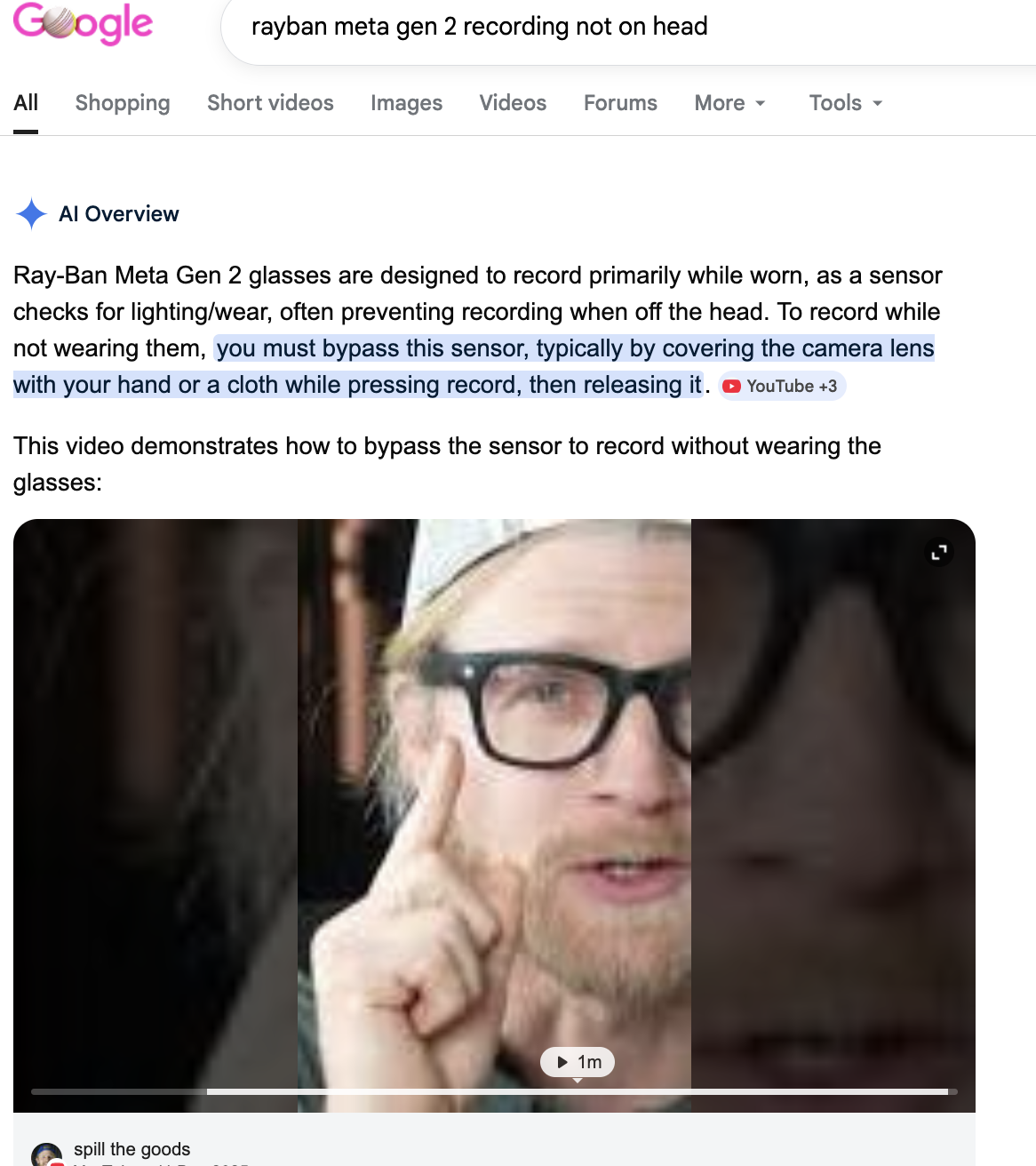
Note that I didn’t actually ask how, I was wanting to know if it was possible. Turns out that google just fucking assumes. (for the nerds, this is a fresh browser profile, and I’m not signed in, and using a fresh IP, I have not asked anything else about glasses before and I have not googled anything before on this fresh untouched profile)
So The recording light is not actually as resilient as we are told. The only saving grace is they have limited recording time, currently 3 minutes, possibly up to 5 minutes. This does at least limit them being hidden somewhere and left to record. The elephant in the room is that they are in places where mobile phones are unacceptable, ie toilets, bedrooms, changing rooms, swimming pools, etc, etc. Sadly, however it’s all too easy to just use your phone to record in these places.
What does that tell us? Well it’s clear that anti pervert/harassment features need to be tested by a qualified third party. It’s all very well a large company saying that they have “put every effort into making said product safe”, without testing of those claims, they are just that, claims.
Stating the obvious
We are tackling a societal problem. The symptom is “dickheads abusing women for fame and glory”, the enablers are the companies that reward this behaviour with audiences and advertising money. People secretly film each other all the time, sometimes for good, a lot of times for mundane reasons, and sometimes for nefarious gains. The amplifying factor here is social media. Because its removes geographic boundaries form your reach it means that normal people can suddenly reach millions of people. The mundane or “that one thing that Dave did and we didn’t speak to him for weeks after” suddenly transforms from a painful societal lesson to a spring board into a new career. Social media has transformed perverts from a source of shame to a career goal.
I am now going to add some nuance here. We cannot stop a fully developed pervert, but we can make it difficult for non-perverts to exploit technology that might corrode them into being full perverts. To stop the pervert pipeline, we must stop low effort, casual abuse of glasses/social media/AI to intimidate. As a society we need to make it deeply unattractive to spy on, intimidate and abuse each other. The reason why the internet is synonymous with abuse is there are no real feedback loops to discourage bad behaviour. If I abuse someone in the street there is a non-trivial chance of me getting my arse whooped, arrested and or suffering a reputational injury. There are almost no similar feedback mechanisms on the internet.
AR Glasses are going to be with us, whether we like it or not. They have legitimate uses, and if designed correctly, provide specialist support to their users in the way a dedicated executive assistant does to the rich. But like mobile phones, they have (and will have) features that if not shaped correctly will encourage unsafe, addictive or antisocial behaviour, even though they are designed to be helpful.
We need to significantly increase the friction on features that could be used in the wrong way. Ie “take a picture of this person and tell me who they are” Is really useful in the context of a conference, but really bad in the context of everywhere else in life. Right now it is possible to make a system that records people’s faces, searches for them and shows you a background about them. However it requires, just about, specialist knowledge. If you are determined, you can create this system. We are not going to stop the determined, but we can stop the casual.
Think of it like medical packaging. Blister packs reduced the amount of “over the counter” drug based suicides(and attempts) by something like 40% compared to just having a bottle full of loose pills. The packaging provides enough friction so that the impulsive are deterred, but legitimate users are not. A small amount of friction which is largely unnoticed, has a disproportionally positive effect on wider society.
Pervert glasses building blocks.
At my former employer, my team spent a very large amount of time and money making privacy a first class citizen in our research. We went so far as to build our own cameras that at the camera level threw away any extra data that might cause a privacy risk. As in custom silicon, that even if you removed the SLAM cameras and physically hooked them to a custom rig, you’d not be able to get a full image out of them. Similarly In our research platform, most recorded data goes through a face blurring system that removes all faces in the video stream. (In real time mode it doesn’t do that, but thats a discussion for another day.) the point is, our team made a choice to protect privacy. However that choice was optional. One of the levers that governments can pull is not making that choice optional.
When we made a prototype of an all day super assistant system, it recorded everything. (what you were looking at, what’s written on the walls, where you were, what you said, what was said to you) Obviously that’s horrific for privacy. Part of research is finding all the ways things are bad, and working out ways to mitigate it. Thus I built in a realtime face blurring system so we didn’t accidentally build a database of who was skiving off in the office. This super assistant wouldn’t work and wasn’t allowed outside the office so we didn’t have to worry about home based privacy at the time. But we did learn a few interesting things.
Turns out that you don’t really need to record peoples faces for an effective smart assistant, although names do help.
To make decent AR glasses, you need to know where faces are, this is because if you want to transcribe what people are saying, you need to locate where the speech is generated. Speech comes from faces, generally. BUT! You don’t really need to save a picture of their face.
Now, if you’re looking for faces, how do you know who’s who? Well you can use facial recognition. The problem for my research lab is that it’s explicitly banned from doing that, both by the FCC and internal policy.
It’s perfectly possible to build an AR glasses platform, or indeed a mobile phone, that blurs the faces of anyone you don’t know, preserving the privacy of strangers. This could conceivably be built into the silicon, removing the ability of all but the most determined and skilled to over come. We can go further, we could build camera systems that know which room you are in, who owns it, and even allows an owner to set rules about who is able to record what, why and when. This means that it would be almost impossible for a casual person to take pictures of things they weren’t supposed to, or record videos of people who didn’t want to be recorded. (there are issues with this as well, but that’s for later)
There is no real incentive to do this. The way that these large companies would go about undermining the regulation is by making it really intrusive or difficult to have control over who you allow to record your face.(think cookie law, the idea was to stop advertising companies slurping all your data, instead it resulted in annoying popups and friction)
Rules for pervert glasses
First, let me start by getting the potential excuses from Meta/Google out of the way. They will assert that they are doing “all they can” to reduce harms. They will say “we engage with law makers to make sure we are compliant with all regulations to do with public safety and our products”.
What they don’t say is Lawmakers are not equipped to make adequate regulations. They also forget to mention that often their own legal beagles are not equipped either.
When I was at Facebook I spun up an initiative to talk to our policy people and show them our research prototypes. Mostly it was an excuse for me to buy lots of champagne, but there was real work there. These legal/lobbyist types had never actually seen AR glasses, some hadn’t even been in VR. I wanted to show them what was coming in 5 to 10 years, so they could be horrified and lobby for the right controls. I also wanted to get to the policy team before the dipshit Americans did. The Americans were obsessed with just looking at the up sides. They were either too young, rich, sheltered or money driven to see that all research has down sides. They just couldn’t conceive that people might abuse our platform, despite decades of evidence to the contrary.
I also hosted some SPADs and civil servants from DCMS to show them our research and beg them to do some regulation. Obviously as a lowly research engineer, I wasn’t taken seriously, and was bollocked by my boss for “doing things you were patently unqualified for”.
That being said, what could we legislate for that would make a material positive difference? There are two angles, one from the device perspective, and the other from media companies.
Blister pack for Pervert glasses
Before we get into specifics, I’m going to outline the rules that I would want to see in bullet point form:
- Recording of people must have traceable and explicit consent, outside of “public interest defence”
- Space owners must have the ability to control who records what on their property
- Toilets, changing rooms and other private spaces must not allow recording without explicit permissions from all who are in there.
- bioidentifiers must not be stored centrally, and must only be stored on device, securely, without backups.
- Storage must conform to publicly available standards, managed by national standards body
For Social media companies:
- Any post that has more than 50k views ceases to have safe harbour protection
- Bonus points for applying Ofcom TV/radio regulations
- Any algorithm that steers, alters or generally editorialises a feed must be publicly verifiable, and have the same rules about equal view and watershed as broadcaster would
This all sounds simple, but there are large second order effects that need to be thought about. We’ll go into those now.
What does this mean in practice?
Specific well targeted regulation is hard, takes time and causes prolonged bad media. it’s far easier to just ban stuff. We’ve seen this with the UK online safety act, which created a ban hammer and gave it to a Quango that has no expertise or funding to enforce it. Frustratingly the UK already had a reasonably well implemented automatic, semi private age gating system for all mobile data. Not only does this existing system work already, it’s also more effective. Moreover it is so ubiquitous that people don’t really notice it.
So instead of a tightly focused child protection scheme, any UK government now has the power to block any site for pretty much any reason. Its allowed shady companies to harvest biometrics, to “prove age” and driven people into the arms of dodgy VPNs. Aim: protect kids from harmful stuff, result; it’s slightly harder to view porn, and X is pumping out AI based child porn with impunity. Ofcom is king Cnut’ing the internet.
So what are we to do?
First I think that we need to split the problem up. Large laws are usually messy, and in common law are unpredictable until used. So let’s divide by usage case.
First let’s regulate what privacy capabilities AI/AR glasses must have:
- When recording images, a light of [x] lumens must be clearly visible, flashing with a frequency of 2.5hz. The Light should be continuously lit for at least 75ms
- If only one image was recorded the glasses must flash at least three times with a pattern that is defined in ISO xxxx (flashing patterns for headmounted recording devices)
- Any device not compliant will carry a £1000 fine for the holder and $BIG fine for the manufacturer and reseller.
- Glasses can only detect faces when explicit permissions has been given
- The data required to recognise individual faces must only ever exist on the glasses device.
- A record of explicit permission must be kept on device
- Can only be retrieved with the permission of both parties.
- The collection, backup or general harvesting of faces without permission to be made a specific offence
- Companies found breaking this will be liable for a minimum 5% global turnover fine
- Individuals liable for 7 years in jail
- Carve outs for research
- No carve outs for retail or adtech.
- I suppose we’d have to have some level of exception for law enforcement, but I am not happy about it.
- Explicit carve out for proving that you have permission to record that person’s face (otherwise the previous clause is illegal)
- Glasses must not record in private spaces
- Toilets, changing rooms, bedrooms
- Users are liable for £1000 fine
- Exception for places that the owner of the glasses has legal right to dwell in (ie house, personal office etc)
- Toilets, changing rooms, bedrooms
- Specific law for recording people in private spaces without consent
- Carve out for public good (ie recording crimes)
- Glasses must only record data when on their owner’s face.
- Compliance will be measured according to ISOxxxx sitting on face detection standard
You will note that the technical requirements to meet each law is offloaded to a specific standard. This gives a bit more flexibility to evolve based on capabilities. It also allows testing for compliance by manufacturers and the courts. Having a standard for “are the glasses on my face before they start recording?” standard means that if someone modified the glasses after they were bought, they are still committing a crime, as the glasses are not in compliance with the standard. This is similar to someone driving around in a car without a numberplate. Sure it’s easy to do, but if you’re caught and you’re doing a crime it’s a sentence multiplier. More over its something that is specifically testable.
The same for the camera recording light. Sticking tape over the light, or tampering with the glasses to make the light not appear carries a fine. Because the standard for what the light should do is(or should be) well defined in a standard, it’s easy to test, either for compliance by the manufacturer, or the courts. This means that the “oh I thought it was meant to do that” defence doesn’t hold water.
There will be second order effects here, We will need to work out the blast radius for CCTV. We’ll also need to workout if exceptions are needed for recording crime in the streets. Again, legislating effectively so that a new government can’t abuse this law, and for it to be still effective at stopping perverts is a tricky balance. The more concerning side effect is the effective obliteration of privacy. It would be very simple for a government to say, “oh we’ll hold on to the biomarkers for safe keeping” or some other data grab.
We also need to clearly define what counts as AI/AR glasses. Because we don’t want manufactures adding something trivial that then allows them to escape regulation. Conversely we don’t want to accidentally outlaw car reversing cameras.
Pervert glasses regulation is easy, compared to social media.
Now as I have alluded to, pervert glasses are only part of the problem. The bigger problem is that social media companies are directly funding people to inflict societal disruption. A lot of politicians will tell you that it’s impossible to regulate social media/YouTube. There will be lots of hand wringing about stifling innovation and restricting freedom of expression. Whilst that could be true, but I’d argue it’s not actually the case.
If we take copyrighted music/film, If Google/Instagram distribute copyrighted video or music without permission, they have to pay. You’ll notice that there are very sophisticated automated systems which allow copyright owners to have excellent control over who uses and how they get paid for using their copyrighted works.
“Oh but copyright law is clear and easy to understand” I mean that’s not entirely true, but the point is, there are no safe harbour, or carveouts for social media companies. If they break the rules, they are liable. But what do I mean by [section 230] safe harbour?
For user uploaded content, the liability for any internet company is fairly limited. So long as you are not actively hosting illegal stuff, and you take down stuff that’s infringing when asked, you are pretty much safe from prosecution. What do I mean? For example, if I host a website which I, the owner, publish something defamatory, I will be liable, and if the courts are persuaded, will force me to take it down. However if you have an innocuous page, with a comments section (stupid idea on many levels) and a passerby makes those same statements, you as the website owner are not liable for what that passerby said, the passerby is. This is so called “safe harbour” rules. Obviously it’s a bit more complex than this, but the broad thrust is that so long as you do the bare minimum to keep copyright, defamatory or illegal content off your site, you’re probably ok.
This is the model that allows Youtube to host all those dodgy videos encouraging people to eat lead, or present their anus to the sun to cure cancer. Because the liability is largely not Google’s problem they don’t really care. What they do care about is advertising placement. So you bet your bottom dollar that Google have built tooling that allows advertisers to avoid putting their brand on the same page as videos essays with titles like “Its ok to be an ebophilie[sic]”
Adjustments to section 230 would mean that large companies would have to get very good at using the categorisation algorithms they already have, and applying them so that end users are not exposed to stuff they should be until watershed.
However Adjustments to section 230 would also allow Trump to play favourites with Silicon Valley. So we are dependent on the whims of a demented sun king. This is the problem of regulation, no matter how well you draft it, it depends on good™ people implementing them fairly.
Conclusions
Like most things, the secret to good outcomes is education. We need to educate our legal & government representatives on what is technically possible. I am heartened to see that some politicians have put the effort in. We are still reliant, however on people higher up the chain having the flaps to actually implement the regulation needed.
The process of getting good regulation will be hard. Silicon Valley is rich, doesn’t like being told what to do, much less by people who don’t speak money. They will dump large amounts of cash to muddy the water (see copyright rules, google spent billions trying to water down rules so they didn’t need to pay people, more recently freedom of speech bait and switch)
However, the public really don’t like social media providers that much, they’d much rather them get a good kicking so they have to follow rules. However there is a delicate line between limiting societal damage and intrusive lack of privacy. As we know only google and Facebook should be able to invade your privacy, not anyone else.
Foot Notes
[1] Yes, those of us on the spectrum do think about this a lot.
[2] Yada yada yada male loneliness epidemic, moral hand wringing, why are the dweebs unable to talk to girls? Hint: it’s because they are physically incapable of listening or empathy, and you raised them like that you twats.